
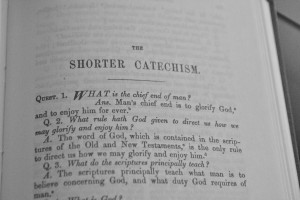
How much theology is wrapped up in saying that the primary goal of humans is to glorify God and enjoy Him forever? So much… and all of it a blessing to receive!
Here are the continued explanatory points from the first article. Be blessed in receiving these — meditate on them and allow them to lead you higher in devotion, in praise and thanksgiving!
A sweet preview: Question 36 talks of “trysting places,” where God covenants to meet with us — the eternal God of the universe promises to reveal himself to us in holy places. Such sacred trust! Hallowed trysts… great joy and rejoicing! Pleasures forevermore await us as we meet Him where He promises to be found!
ANSWER: Man’s chief end is to glorify God, and to enjoy Him forever.
Continued explanatory questions and answers:
A. It is what he is absolutely in himself. Exod. 3:14 — “I Am That I Am.”
Q. 9. What is his declarative glory?
A. His showing, or making known his glory, to, in, and by his creatures, Isaiah 44:23; 2 Thess. 1:10.
Q. 10. Can any creature whatsoever add anything to God’s essential glory?
A. No; for his essential glory is infinite, eternal, and unchangeable, Job 35:7.
Q. 11. Do not the heavens and the earth, and all inferior creatures, glorify God?
A. Yes; in a passive way, all his works praise him. Psalm 19:1, and 145:10.
Q. 12. How ought man to glorify God?
A. Man being endued with a reasonable soul, ought to glorify God in an active way, Psalm 63:4, by declaring his praise, Psalm 103:1, 2; and essaying to give him the glory due to his name, Psalm 96:7, 8.
Q. 13. How was man to glorify God in a state of innocence?
A. By a perfect, personal, and perpetual obedience to his law, Gen. 1:27; and by giving him the glory of all his works, chap. 2:19.
Q. 14. Has man answered his chief end?
A. No; for, “all have sinned, and come short of the glory of God,” Rom. 3:23.
Q. 15. Has God then lost his end in making man?
A. No; for God will glorify his justice and power upon some, and his grace and mercy upon others of Adam’s family, Rom. 9:22, 23.
Q. 16. Was ever God glorified by a perfect obedience since Adam’s fall?
A. Never, until CHRIST, the second Adam, appeared as a new covenant head, Isaiah 42:21, and 49:3.
Q. 17. How did Christ, the second Adam, glorify God, as our surety and representative on earth?
A. By finishing the work the Father gave him to do. John 17:4.
Q. 18. What was the work the Father gave him to do?
A. It was to assume a holy human nature, Luke 1:35; to yield a perfect sinless obedience to the whole law, Mat. 3:15; and to give a complete satisfaction to justice, for man’s sin, by his meritorious sufferings and death, Luke 24:26.
Q. 19. How does Christ glorify God in heaven?
A. By appearing in the presence of God for us, Heb. 9:24, and applying, by the power of his Spirit, that redemption which he purchased by the price of his blood on earth, Titus 3:5, 6.
Q. 20. When is it that a sinner begins uprightly to aim at the glory of God?
A. When, through a faith of God’s operation, he believes in Christ: Acts 8:37, 39. — “The eunuch answered and said, I believe that Jesus Christ is the son of God. — And he went on his way rejoicing.”
Q. 21. Can no man glorify God acceptably, unless he first believe in Christ?
A. No; for, “Without faith it is impossible to please him.” Heb. 11:6; and, “Whatsoever is not of faith is sin,” Rom. 14:23.
Q. 22. How is it that faith in Christ glorifies God?
A. As it sets its seal to the record of God, John 3:33; and unites us to Christ, from whom only our fruit is found, Hos. 14:8.
Q. 23. Is not God glorified by the good works of believers?
A. Yes; “herein,” says Christ, “is my Father glorified, that ye bear much fruit,” John 15:8.
Q. 24. What are these fruits brought forth by believers, by which God is glorified?
A. They may be summed up in faith working by love, Gal. 5:6; or, their aiming, in the strength of Christ, at universal obedience to the law, as the rule of duty. Phil. 4:13 — “I can do all things through Christ which strengtheneth me.”
Q. 25. How should we glorify God in eating and drinking?
A. By taking a right to the supports of natural life, through the second Adam, the heir of all things, who has purchased a covenant right to temporal, as well as spiritual mercies, for his people, 1 Cor. 3:21-23; and thankfully acknowledging God for the same, 1 Tim. 4:4, 5.
Q. 26. How must we glorify God in our religious worship, and other acts of obedience?
A. By doing all that we do in the name of the Lord Jesus, Col. 3:17; worshipping God in the Spirit, rejoicing in Christ Jesus, and having no confidence in the flesh, Phil. 3:3.
Q. 27. What is it, next to the glory of God, we should aim at?
A. Next to God’s glory, we should aim at the enjoyment of him, Psalm 73:25, 26.
Q. 28. Why should we aim at the enjoyment of God?
A. Because he is the chief good of the rational creature, Psalm 116:7; and nothing else besides him, is either suitable to the nature, or satisfying to the desires of the immortal soul, Psalm 144:15.
Q. 29. How may a finite creature enjoy an infinite God?
A. By taking and rejoicing in him, as its everlasting and upmaking portion, Psalm 16:5, 6, and 48:14.
Q. 30. Did our first parents, in a state of innocence, enjoy God?
A. Yes; there was perfect friendship and fellowship between God and them; for, “God made man upright,” Eccl. 7:29.
Q. 31. What broke that blessed friendship and fellowship?
A. Sin: our iniquities have separated between us and our God, and our sins have hid his face from us, Isaiah 59:2.
Q. 32. Can a sinner, in a natural state, enjoy God, or have any fellowship with him?
A. No; for, “What communion hath light with darkness? and what concord hath Christ with Belial?” 2 Cor. 6:14, 15.
Q. 33. How may a lost sinner recover the enjoyment of God, and fellowship with him?
A. As we lost it by our fall in the first Adam, so it can only be recovered by union with a second Adam, Rom. 5:18-19; for there is no coming to God but by him, John 14:6.
Q. 34. When is it that a sinner begins to enjoy God?
A. When, having received Christ by faith, he rests upon him, and upon God in him, for righteousness and strength, Isaiah 45:24; and out of his fullness receives, and grace for grace, John 1:16
Q. 35. What are the external means by, or in which, we are to seek after the enjoyment of God?
A. In all the ordinances of his worship, public, private and secret; such as the word read and heard, the sacraments, prayer, meditation, fasting, thanksgiving, and the like.
Q. 36. Are the saints of God admitted to enjoy him in these?
A. Yes; they are the trysting-places where his name is recorded, and to which he has promised to come and bless them, Ex. 20:24 — “In all places where I record my name, I will come unto thee, and I will bless thee.”
Q. 37. What scripture-evidence have we, of their enjoying God in the duties and ordinances of his appointment?
A. We find them much employed in religious duties, Song 3:1-3; and expressing the utmost regard for the ordinances of his grace, Psalm 84:1, 2.
Q. 38. What satisfaction has the soul in the enjoyment of God?
A. Unspeakably more gladness than when corn, wine, and all earthly comforts, do most abound, Psalm 4:7
Q. 39. Is there any difference between the enjoyment of God in this life, and that which the saints shall obtain in the life to come?
A. Not an essential, but a gradual difference, as to the manner and measure of it.
Q. 40. What is the difference as to the manner of the enjoyment here and hereafter?
A. Here, the enjoyment is mediate, by the intervention of means; hereafter, it will be immediate, without any use of these means: “Now we see through a glass darkly; but then FACE TO FACE,” 1 Cor. 13:12.
Q. 41. What is the difference as to the measure of the enjoyment, in this life, and that which is to come?
A. In this life the enjoyment is only partial; in that which is to come, it will be full and complete, 1 John 3:2 — here, the enjoyment is only in the seed, or first fruits; there it will be in the full harvest, Psalm 126:5, 6.
Q. 42. Is the partial enjoyment of God in grace here, a sure pledge of the full enjoyment of him in glory hereafter?
A. It is both the pledge and earnest of it, Eph. 1:13, 14; Psalm 84:11.
Q. 43. Does the gracious soul, in that state, fully receive its chief end?
A. Yes; in regard that then it shall be brimful of God, and celebrate his praises with high and uninterrupted Hallelujahs through all eternity, Psalm 16:11; Isaiah 35:10.
Q. 44. Why is the glorifying God made the leading part of man’s chief end, and set before the enjoyment of him?
A. Because, as God’s design in glorifying himself was the reason and foundation of his design in making man happy in the enjoyment of him, Rom. 11:26; so he has made our aiming at his glory, as our chief end, to be the very way and means of our attaining to that enjoyment, Psalm 50:23.
Q. 45. Is our happiness, in the enjoyment of God, to be our chief end?
A. No; but the glory of God itself, Isaiah 42:8; in our aiming at which chiefly, we cannot miss the enjoyment of him, Psalm 91:14, 15.
Q. 46. Is not our delighting in the glory of God, to be reckoned our chief end?
A. No; we must set the glory of God above our delight therein, otherwise, our delight is not chiefly in God, but in ourselves, Isaiah 2:11. Our subjective delighting in the glory of God belongs to the enjoyment of him, whose glory is above the heavens, and infinitely above our delight therein, Psalm 113:4.
Q. 47. Whom does God dignify with the enjoyment of himself, in time and forever?
A. Those whom he helps actively to glorify and honor him; for he has said, “Them that honor me, I will honor,” 1 Sam. 2:30.
Q. 48. Does anything so much secure our happy enjoyment of God, as the concern that the glory of God has in it?
A. No; for as God cannot but reach the great end of his own glory, so, when he has promised us eternal life, in Christ, before the world began, Titus 1:2, we cannot come short of it; because it stands upon the honor of his faithfulness to make it good, Heb. 10:23 — “He is faithful that promised.”
Q. 49. How does it appear, that the enjoyment of God, which is connected with the glorifying of him, shall be forever?
A. Because he who is the object enjoyed, is the everlasting God, Isaiah 40:28; and the enjoyment of him is not transitory, like the passing enjoyments of time, but the eternal enjoyment of the eternal God, Psalm 48:14.
Selah